Your Next Customer
Isn't Human.
We sit at the beginning of a new year when speculation is rife and uncertainty assured. Topping the most speculated list we expect AI to reign supreme...or perhaps heads of state to be abducted. We will focus on the former for now.
The evolution of existing apps and models, such as ChatGPT and Gemini, will likely continue to snatch headlines; as will new products flying off the ever-expanding AI production line. However, an announcement last year that seemingly went under the radar caught our attention – and we expect that it will soon catch yours too.
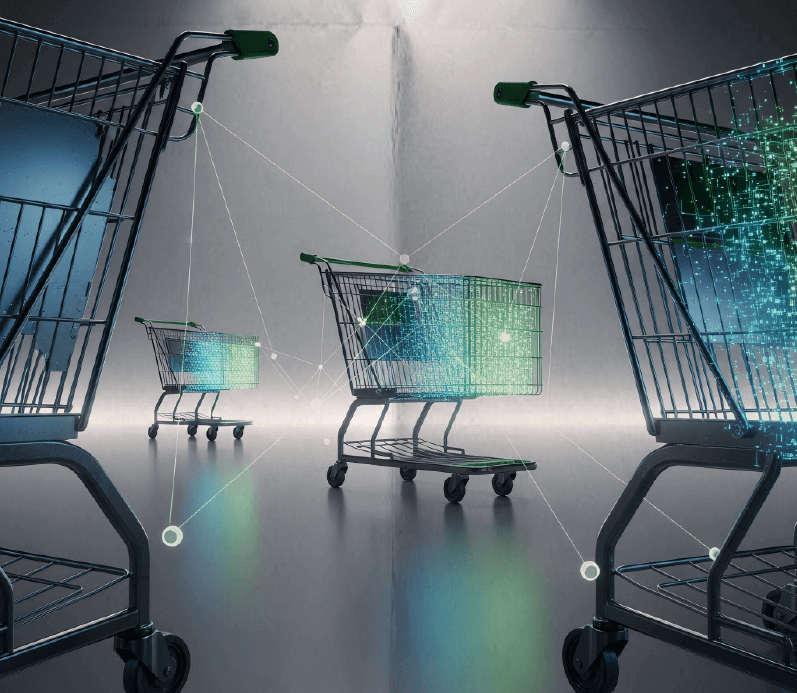
Last September, OpenAI, alongside Stripe, took its first real step towards agentic commerce, launching the Agentic Commerce Protocol. In doing so, they open-sourced the rules, interfaces and standards for how agents can complete commercial activities. Agentic commerce, a sub-section of agentic AI, enables agents (AI bots) to act on a user’s behalf. In the case of OpenAI, they used their model to introduce Instant Checkout on ChatGPT, allowing users to buy directly from platforms such as Etsy and Shopify without leaving the app.
While this is a tentative entry, it is an early signal of a significant shake-up in the e-commerce marketplace; and if the past three years are anything to go by, we can expect rapid development. What could this look like?

This is a simple example – an optimistic, but feasible reality for 2026. Crucially, it marks the beginning of a future where ChatGPT evolves beyond a chatbot and into a personal assistant, one that knows which subscriptions we are paying for, when bills are due, and predicts our lifestyle habits. Extend the scenario slightly further and an agent may suggest that since the user recently bought carrots and chopped tomatoes, they don't need to buy more.
This is the ostensibly frictionless world we are entering, and it raises a few questions.
- 01: Are humans the friction in the marketplace?
- 02: Is this safe?
- 03: How do brands communicate with their consumers?
To answer these
sequentially.
- 01: Yes, the transaction chain flows more smoothly without human interaction. Humans, by nature, assess options more discriminately and behave irrationally, which creates uncertainty and inefficiency. Bots, on the other hand, can assess larger amounts of data, bringing speed and accuracy to buying decisions. Yet, brands and marketing often require inference – a trait innate to humans.
Maybe we should be asking: is friction so bad?
Which segues into safety. - 02: Projective identification, the psychoanalytic theory where someone projects their feelings or opinion onto someone else to carry, is evident in the way humans interact with chatbots. In turn, this builds trust and attachment. If AI apps become financially incentivised – for example, if a chatbot takes a fee for facilitating a transaction there is an incentive to suggest higher value transactions – the risk of exploitation grows starker. Governance structures may guard against theft and other obvious misuse, but in the ever-murkier world of AI, an increase in agency is an increase in risk. Entrusting an agent with our decision making and unrestricted access in our lives may be met with resistance, but convenience usually prevails.
Yet it is - 03: in how businesses communicate that the real interest lies. In its simplest form, agentic commerce will shift value creation upstream. Brands begin to compete less for attention and more for adjacency to systems that decide. Where social media made brands think expressively, AI will reshape marketing into data legibility, platform partnerships, benchmark inclusion, review structures and integration quality. Like humans, AI programs are limited by bounded rationality, and will use satisficing decision-making to meet the minimum requirements of the user as quickly as possible and with the least computational output. In the same way brands have learned how to capture human attention, they will now need to learn what agents are looking for.
The baby food market offers an interesting parallel to the realities of this new marketplace. Baby food is a sector where the customer and consumer are different. Brands communicate information that the customer values – nutritional values, purity, safety – in a tone and style that reflects the consumer. With agentic commerce, brands need to satisfy the heuristics the agent seeks, in a way that reflects the user’s interests.
Business don’t need to fret yet. If generative AI is still in its infancy, agentic commerce may just about be emerging. It is worth noting, however, that this represents the clearest route so far to profitability for generative AI – a way out of the of the money pit it is currently digging. In a world where the customer and consumer are distinct, and the insentient are our decision-makers, establishing an aligned brand and communications strategy has never been so important.
The next advantage will belong to the brands that understand how they are read, ranked, and trusted by agents. And by humans.
We look for
what matters.
MOJO THE BRAND +
COMMS CONSULTANCY
DEFINED BY RADICAL
CLARITYTM.
POWERED BY
INTELLIGENT
MOMENTUMTM